
What “Leaderless” Actually Means
By Kinuthia Ndung’u and Wanjira Wanjiru
Image Credit: PATRICK MEINHARDT/AFP via Getty Images
Gen Z protests are about more than a generation. Uprisings like the one we helped lead in Kenya are rewriting how movements organize, and how states fight back.
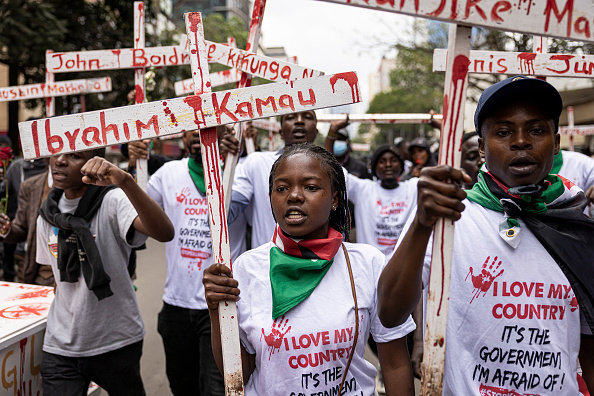
When Kenya’s Gen Z uprising forced President William Ruto to withdraw a controversial 2024 finance bill, the world took notice. Within weeks, the story was everywhere: A horizontal, leaderless, seemingly youth-led movement had done what conventional opposition leaders had failed to do. Here was proof, commentators argued, that social-media-native organizing could match or surpass the power of parties, unions, and formal civil society.
The “leaderless” label has become a frame that obscures more than it reveals. The uprising was not unled; rather, it was intentionally organized without a single claimable public leader. That distinction matters, and we want to be explicit about it from the start: A movement can be genuinely decentralized and genuinely coordinated at the same time. The harder question — which we take up here as organizers who were inside the uprising — is whether that combination is enough not only to win concessions from a government, but to hold on to what was won and build the capacity to fight the next battle from a stronger position.
This is not a uniquely Kenyan question. Youth-led movements have forced governments into concessions in Bangladesh, challenged state power in Indonesia, and are taking shape in India — all organized across digital networks, all facing the same morning-after problem of turning protest energy into durable political power. We write this account as practitioners, not theorists: What follows is a clear-eyed look at what the leaderless model achieved over three years, what it cost, and what we would do differently.