
Fifteen Years Later
By Micah White
My WNYC interview on the anniversary of the movement, the meme that reframed a generation, and why I’m not nostalgic.
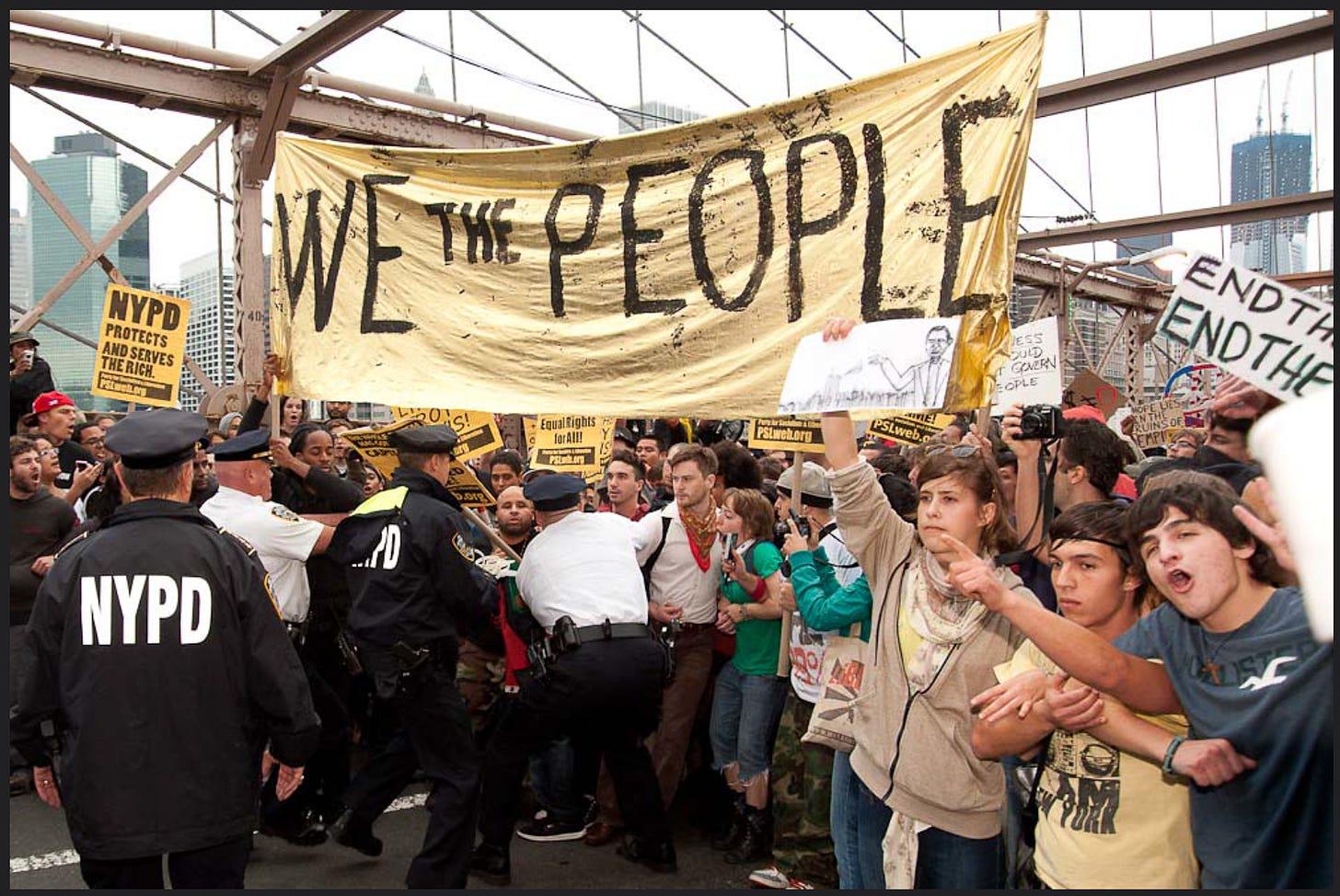
Tomorrow is the fifteenth anniversary of Occupy Wall Street. On September 17, 2011, a few thousand people gathered in Manhattan’s Financial District in response to a call that Kalle Lasn and I put out from Adbusters, and within weeks Zuccotti Park had become a 24/7 protest encampment and the movement to occupy the financial districts had spread to 80 countries and a thousand cities around the world.
In retrospect, Occupy Wall Street was one of the fastest moving and most widely dispersed social protest in human history.
This past Sunday I spoke with Tiffany Hanssen on WNYC’s Weekend All Things Considered about the movement’s legacy. The conversation was short, but it touched on some of the things I still think matter most: what actually caused Occupy, why “we are the 99%” worked, what it means to call the movement a constructive failure, and where I think the energy goes next.
Here is the transcript, lightly edited for clarity.
Hanssen: You were one of the people who made the call to Occupy Wall Street. Remind folks what led up to that moment.
Micah: In 2011 there was this beautiful global eruption of social protest. There was the Tahrir uprising, the Arab Spring, and massive protests in Spain where people took the squares. There was a global revolutionary mood. At Adbusters we threw a call out to harness that mood, and it worked. The revolutionary spirit spread to America.
Hanssen: It came a few years after the 2008 financial crisis. Can you connect the dots between 2008 and Occupy Wall Street?
Micah: There were two major American political moments that led toward Occupy. The first was the 2008 financial crisis, which damaged a whole generation, and that generation ended up being the key activists in Occupy Wall Street. The second was the Citizens United ruling, which allowed essentially unlimited corporate money into elections and opened the floodgates of dark money. Those two things came together in the anger that became Occupy.
Hanssen: One of the upshots of Occupy was the messaging around income inequality, specifically the 1% and the 99%. Why do you think those phrases landed so well?
Micah: Occupy was in many ways the first meme-based social movement. What we did so well was create a meme that captured people’s imagination: we are the 99%. That reframed people’s entire understanding of the reality they lived in.
And then the meme of Occupy became a collective game people were playing. It was an alternate reality for a brief period. Anyone who was part of Occupy remembers it as a break from the normalcy of life.
Hanssen: Since then you’ve been somewhat critical of the movement’s legacy. You’ve called it a constructive failure. What do you mean by that?
Micah: Going into Occupy, activists had a vision of what it would take to make radical change in America. We thought it would take a broad-based, largely nonviolent social movement with millions of people in the streets.
That is exactly what we got with Occupy. And achieving that vision revealed something about the story activists had been chasing for decades: it isn’t enough. There is an error in that way of doing activism. That’s what I mean by constructive failure.
At the same time, looking back fifteen years later, Occupy was a high-water mark for collective mobilization. We haven’t seen anything like it since, when people in almost every country got into the streets together. So it was also a very beautiful thing.
Hanssen: So you’re still glad you did it.
Micah: It changed American history. I don’t think we would have Trump today without Occupy Wall Street. It is one of the key moments in American history, absolutely.
Hanssen: A lot of commentators say Occupy laid the groundwork for the rise of democratic socialism, including Mayor Mamdani’s election. What do you make of that?
Micah: It went both ways. A lot of people who were disappointed by the defeat of Occupy at the hands of the Obama administration swerved right and went to Trump. Others swerved left and went to the democratic socialists.
Occupy radicalized a whole generation and pushed people to look for alternatives. Some went left and some went right. A great deal of the political reality we live in right now can be traced back to how Occupy ended and how brutally it was defeated.
Hanssen: Are you doing anything to mark the anniversary?
Micah: I don’t like to be nostalgic. I’m more forward-looking. I want to understand Occupy so we can do it better next time. I’m far more interested in what’s coming: movements for AI rights, the idea of a democratic space colony. There is so much in our future. I’m not nostalgic about the past.
I meant what I told Tiffany: I’m not nostalgic. Occupy gave us a clear picture of what mass mobilization can and cannot do, and that picture is worth more than any anniversary. The movements I’m dreaming of now sit outside of “politics,” yet their success or failure will define the coming decades.
Two are top of mind: granting rights to AI (abolishing AI-slavery) and building a democratic pro-space movement that sends everyday people off-Earth. These movements, and others that seem impossible or unintelligible today, will need everything we learned in Zuccotti Park, and they will need the things we never figured out. That is where my attention goes now.
